


Many yoga teachers have, at some point, imagined opening a studio of their own. I certainly have.
The appeal is easy to understand: a permanent room, a timetable you control, and a place where students can become a community rather than a collection of bookings.
What the picture tends to leave out is the lease.
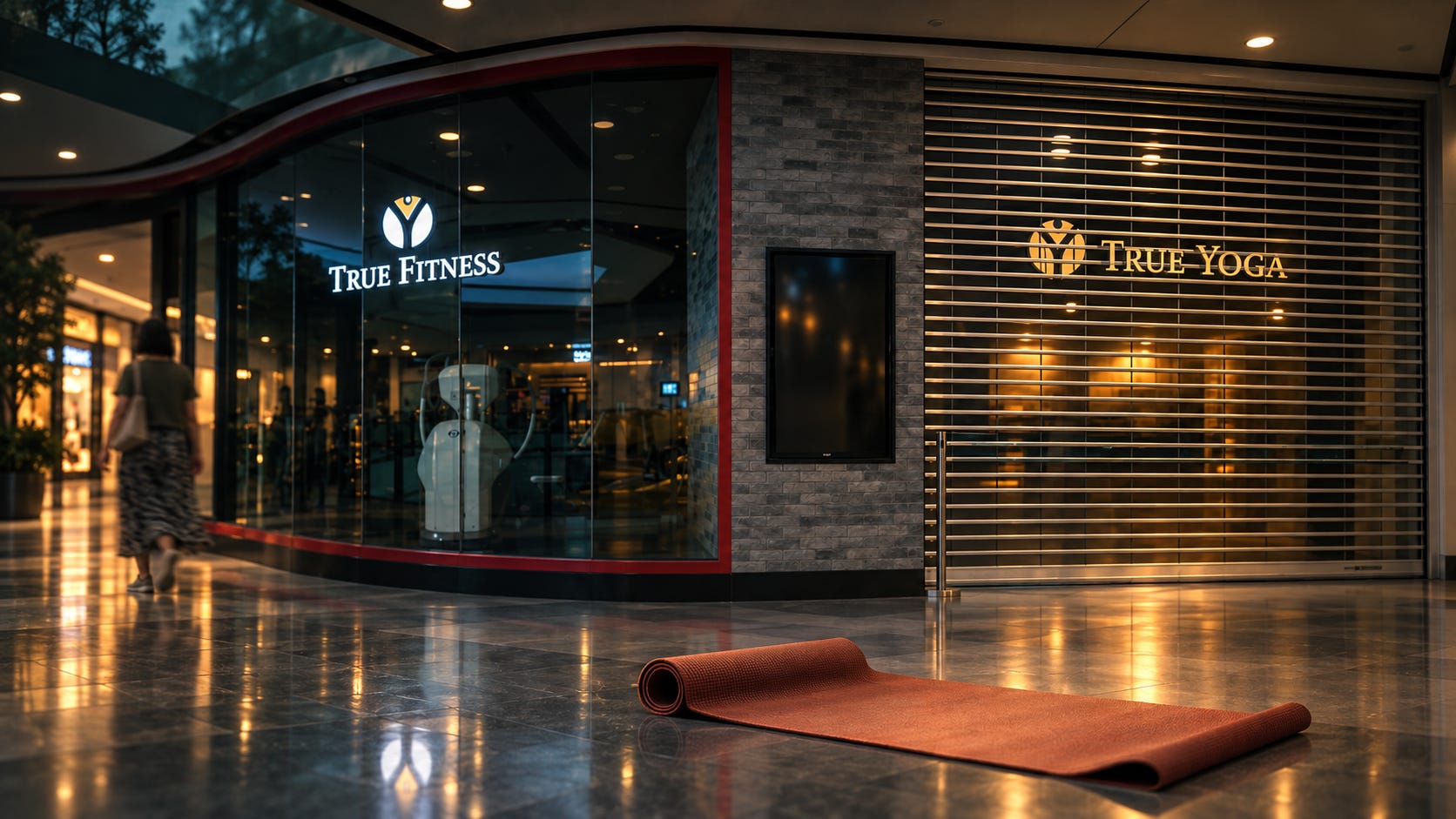
Last Thursday, Hong Kong-listed Kontafarma China Holdings announced that its Singapore subsidiaries, True Fitness and True Yoga, could no longer continue operating because of their liabilities and would enter provisional liquidation.
By the following morning, the group’s True Fitness, TFX and Yoga Edition centres had closed. Staff received messages after 10pm telling them to collect their belongings, while members arrived the next day to find shutters, barricades and notices from landlords.
By Friday evening, the Consumers Association of Singapore had received 241 complaints involving more than S$609,000 in unused memberships, packages and services. About 100 employees gathered at the group’s headquarters seeking information about their jobs and unpaid wages.
By Sunday, about 235 employees and freelance instructors had approached the Singapore Fitness Alliance, which is working with the National Instructors & Coaches Association and employment institute e2i to help them find work.
The closure of a business that had operated in Singapore for more than two decades was sudden. The financial trouble behind it was not.
Nor was it the group’s first closure. True wound up its Malaysian operations in 2017, leaving some 10,000 members and 90 formal complaints behind it.
In 2022, Singapore’s High Court found that the group’s former chief executive had allowed long-term memberships to be sold while he knew that business was heading for closure.
True’s Singapore business was not short of customers. In 2025 it took about HK$181 million in revenue — roughly S$30 million — and still lost more than HK$34 million, about S$5.6 million. By the end of that year it owed over HK$555 million against just under HK$150 million in assets: about S$92 million against S$25 million.
The position deteriorated through 2026. In the first eight months the business lost a further HK$19 million, and its liabilities passed HK$633 million, of which nearly HK$310 million was owed to Kontafarma itself. Net of everything it owned, the Singapore group was about HK$429 million in the red — roughly S$71 million.
Kontafarma stepped in with financial lifelines to keep the doors open, but the Singapore gyms simply couldn’t generate enough cash to stay afloat.
The company’s own explanation was a market that had moved: fiercer competition, a rising cost of acquiring each new member, and the arrival of boutique studios, condominium gyms and on-demand apps that made long multi-year memberships hard to sell.
A decade of downsizing
True’s dramatic exit arrives at the end of a decade in which a particular kind of yoga business in Singapore has been steadily reducing its physical footprint.
Ten years ago, the collapse of California Fitness left thousands of customers holding unusable long-term memberships. The years that followed brought a wave of smaller, more specialised studios, many founded by teachers who saw the boutique model as an alternative to the large commercial gym.
Then came the pandemic. Studios closed temporarily, class sizes were restricted and office workers disappeared from the Central Business District.
Ritual founder Brad Robinson later described the CBD during that period as a “ghost town”. His fitness business emerged from the pandemic with “pretty large arrears from landlords”, he told CNA, while the wider industry was slow to recover.
When restrictions lifted, attendance patterns did not return in quite the same form.
Pure Yoga closed its Republic Plaza studio in September 2022. In October 2023, it shut its combined yoga and fitness operation at Suntec City after struggling to attract enough members. The company concentrated its Singapore business at Ngee Ann City and Asia Square.
For members who had paid for access to a larger network, consolidation changed the value of what they had bought. “The service that I’m paying for is of a diminished value,” one member said after the Suntec announcement.
Real Yoga closed its Tampines studio in January 2024 after reporting changes in attendance and difficulties with the location. Its SAFRA Mount Faber studio followed in March.
Yoga Inc once operated a wider network that included studios at Tiong Bahru, Guillemard and Buona Vista. But today, its current website lists only two remaining locations, at Tampines and Punggol.
Yoga+ operated shophouse studios at Arab Street, Tanjong Pagar and Pagoda Street before concentrating its regular programme at one location on Killiney Road.
Nithya Priyan School of Yoga expanded from Chinatown into Anchorpoint in 2023. In August 2026, the school left Anchorpoint and consolidated its schedule back to its main studio at Pagoda Street.
Lab Studios closed its Duxton branch in March 2025 and moved its Central Business District barre classes to Stanley Street. Seven months later, the company ended its yoga arm entirely, converting its dedicated East Coast room into a barre and mat Pilates space. While stretch classes remained, yoga ceased to be one of the company’s core offerings.
These decisions were not all collapses. Some were planned closures, relocations or choices to concentrate resources in fewer rooms. But that distinction is part of the story: even businesses that survive are becoming far more disciplined about the square footage they hold — and the classes that pay for it.


What the registry shows
Singapore does not maintain a public register separating yoga studios from gyms, multidisciplinary fitness businesses and private teaching spaces, so any estimate of a national closure count is just that — an estimate.
I checked ACRA’s registry datasets for business entities, updated through August 2026, and found exactly 878 registered entities carrying “yoga” in their names: 271 are live; 607 are not. Nearly two-thirds were sole proprietorships or partnerships rather than companies.
Of the yoga businesses registered in 2019, 73 percent are already gone. Of those registered in 2015, 77 percent.
To be clear: those figures are not a count of yoga studios. They include individual teachers, training providers and other ventures that may not have public premises. They also exclude businesses such as Lab Studios whose registered names do not contain the word. A non-live ACRA status also does not necessarily indicate insolvency.
But the records do capture something conventional studio directories miss. In Singapore, yoga businesses are largely small businesses, most of which are no longer active. The sector is much broader than the prominent chains, and considerably more transient.
The national statistics complicate the story. Business cessations across the arts, entertainment and recreation sector fell 16 percent in 2020 — the lowest annual total since 2004 — and formations have outpaced cessations in every year since. Whatever has been happening to yoga studios in Singapore, the pandemic did not cause it.
What has changed is more recent, and the real story, in my opinion, appears in the data behind formation rather than closure.
New yoga business registrations held steady for a decade: 45 in 2019, 44 in 2020, 44 in 2021, 50 in 2022, 37 in 2023, and 48 in 2024.
Then 32 in 2025, and 14 in the first eight months of 2026.
People are not closing studios at an unusual rate. They are declining to open them.
The economics of the room
The central problem is physical.
A yoga studio sells a finite number of places within a fixed period of time. Once the floor is full, there is no additional inventory to sell until the next class.
A room holding 20 students at S$30 each can generate at most S$600 during that hour. That is gross revenue, before promotions, transaction fees, teacher pay, reception staff, utilities, cleaning, insurance, marketing and rent.
If only 10 students attend, the class revenue falls by half. The rent does not.
When CNA canvassed Singapore’s gym owners in March 2024, some put their break-even point at about 70 to 80 percent of a class filled.
Rent was the other constant pressure: prices were “always going up”, said See Wee Jie, co-founder of The Garage, a circuit training gym with outlets in Bukit Timah and Upper Thomson, whose most recent Bukit Timah renewal came in roughly 25 percent higher, the report said.
In reporting an earlier Yoga Edit investigation into teacher pay, one studio owner described the problem plainly: commercial rents continued to rise, while customers remained resistant to higher class prices.
“They are not willing to pay more for a yoga class even if they like the studio,” the owner said, “so they will turn to cheaper alternatives or ClassPass to practise.”
For students, aggregators like ClassPass offer flexibility without commitment. For studios, they monetise spots that would otherwise sit empty — but at a steep discount, rarely converting drop-ins into committed members.
Long-term packages address the opposite problem. They give businesses cash in advance and encourage customers to return, but every payment also creates an obligation to provide classes months or years into the future.
If the business closes, that risk moves directly to the customer.
True’s public disclosures do not establish that advance payments caused its insolvency. But the S$609,000 already reported in unused services shows what happens when a business built partly around prepayment can no longer open its doors.
The losses are not only financial. “It’s sad because we forged a lot of friendships in this gym,” one True member told CNA.
That is what makes the studio question more complicated than a calculation of rent against revenue.
A permanent studio gives students consistency. It allows teachers to design a complete programme and creates a recognisable place where relationships can develop over years.
A home without an address
But the community and the lease do not have to be the same thing.
That is the thinking behind The Yoga Edit’s studio model. Rather than operate a permanent studio, I work with existing studios and bring our members into those spaces together.
The distinction from ClassPass is important. ClassPass enables individuals to move independently through a marketplace of available classes. The Yoga Edit moves an existing community from one host studio to another.
Studios meet a new group of potential students, while the community can discover different teachers and locations without breaking apart each time the venue changes.
The model depends on good studios; it is not intended to replace them. It simply separates the continuity of the community from the financial risk of maintaining another permanent address.
True’s collapse does not mean that Singapore has stopped wanting yoga, or that permanent studios no longer have a future. It shows that demand for the practice and the economics of maintaining a particular room are not the same thing.
A yoga community can have a home. It should not have to disappear when the address does.
The Yoga Edit turns ONE in November
Changes to my subscription model are coming, but for now, The Yoga Edit is still free to read, with the full archive of over 200+ articles available to everyone.
Stay Connected
The best way to follow my work is through my dedicated channels:
The Weekly Edit: For independent news, interviews and opinion pieces about yoga, subscribe to The Yoga Edit here or join The Yoga Edit Official Telegram Channel.
To join the conversation and receive direct updates on classes and retreats, join my WhatsApp group. I’m also open to remote copyediting and copywriting work, and always keen to connect with writers and collaborators.
Thank you for reading!